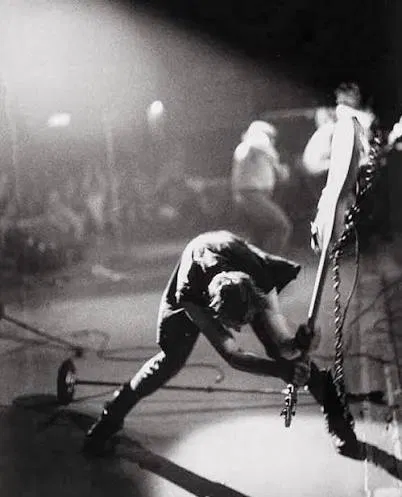
What does this say to you about British music?
What does this say to you about British music?
An instrument about where British music comes from — and where it came from before that.
You know this song.
Where did it come from?
Not geographically. Musically. What does this song sound like it was built from?
Your answer is saved.
Wham! is not a coincidence. Here is what it belongs to.
George Michael grew up listening to American soul and funk. The production on Last Christmas, Wake Me Up Before You Go-Go, Careless Whisper — the synth bass lines, the drum machine patterns, the vocal phrasing — all of it is in direct conversation with Motown, Philadelphia soul, and American R&B. The sources are specific, audible, and largely uncredited in the way Wham! was marketed and remembered.
"I was obsessed with Motown from the age of seven. That's where everything came from."
— George Michael
The Beatles began as a covers band playing American rock and roll and R&B in Liverpool clubs. Chuck Berry, Little Richard, the Everly Brothers, Smokey Robinson — these were the records John Lennon and Paul McCartney learned from. Their early catalogue is saturated in Black American musical tradition. When they crossed the Atlantic in 1964 and were called a British invasion, they were bringing a translated version of American music back to America. The translation was celebrated. The sources were largely not.
"We were just copying American music and presenting it back to them."
— John Lennon
Adele's vocal style draws directly from Etta James, Aretha Franklin, and the gospel tradition — the same South London soul lineage that produced Amy Winehouse. The music industry took that voice and sold it globally as quintessentially British.
"Etta James was everything to me. That's the voice I was always trying to find."
— Adele
Behind the artists are rivers. The same rivers, running through all of them.
These are not influences in the sense of mild inspiration. They are the structural foundations of what Britain calls its own music.
In 1964, The Beatles landed in New York. Ed Sullivan. Screaming crowds. Within months, British acts dominated the American charts. The Rolling Stones, The Kinks, The Who followed. The world called it the British Invasion — Britain exporting its culture, its sound, its identity to the most powerful music market on earth.
It was celebrated as proof of British creative genius. A national triumph. The moment Britain showed the world what it was made of.
Britain exported music that had already crossed the Atlantic in the opposite direction. Blues, gospel, soul, R&B — developed by Black American communities — had travelled to Britain through records and radio. British musicians absorbed those traditions, translated them through white working-class voices, and sent them back.
The translation was celebrated. The source was not.
This is a question about what gets credited, what gets remembered, and who gets written into the national story.
If British music is built from traditions that travelled from elsewhere — what makes it British?
Discuss.